
Material characterisation
Aqueous Gel Permeation Chromatography System (GPC)

Aqueous size exclusion chromatography (SEC) is widely used for determining the molecular weight distributions of various synthetic and naturally occurring water-soluble polymers, as well as for separating oligomers and small molecules. Gel permeation chromatography (GPC) is a form of SEC. The requirement to eliminate ionic and hydrophobic effects makes aqueous GPC very demanding. GPC uses specialised columns for the separation. The PL aqua gel-OH columns provide a chemically and physically stable matrix for reliable aqueous GPC separations. The columns are packed with macro-porous copolymer beads featuring an extremely hydrophilic poly-hydroxyl functionality. The neutral surface and the capability to operate across a wide range of eluent conditions provide for high-performance analyses of compounds.
GPC is used as a polymer characterisation tool. The molecular weight can greatly change the properties of a polymer, from a low molecular weight sample that is quite flexible to a high molecular weight sample that is more rigid.
ANFF-Q has been equipped with an Agilent Technologies Aqueous GPC 1260 Infinity system with RI, UV, viscosity and light scattering detectors, which allows both the measurement of molecular weights compared to reference standards and the measurement of absolute molecular weights.
Examples of use: The Aqueous GPC 1260 Infinity system can be used for the determination of molecular weights of low to very high molecular weights of many biomaterials, PEG, polyacrylates, PVA, cellulose derivatives, starch, etc.
Purpose: Gel permeation chromatography separates based on size exclusion and measures the molecular weight of water-soluble polymeric samples.
Material systems: Polymers/bio-materials.
Scale/volume: 2 mL sample vials, a 100 µL injection syringe and a 1.5 mL sample loop.
Key Features/ Specifications/resolution: Measures molecular weight using either RI, UV, viscometer and light scattering detectors (15 and 90 degrees) in the (range of 500 to 1,200,000 Daltons), an isocratic pump 0.1 to 1.0 mL/min, a 2-port column heater 30 to 60 degrees Celsius and an auto injector capable of holding either 48 x 2 mL vials.
Model: Agilent Technologies Aqueous GPC 1260 Infinity system
Site: The University of Queensland
Location: PC2 Laboratory, Level 2E, AIBN (Bldg #75), St Lucia
Instrument contact: anff@uq.edu.au
Gel Permeation Chromatography System (GPC)

The gel permeation chromatography (GPC) system is a variation of high-performance liquid chromatography (HPLC) using specialised columns that separate on the basis of size exclusion. GPC is specifically used for the measurement of the molecular weight of polymeric samples and is a polymer characterisation tool.
The molecular weight of a polymer can greatly change the properties that it will have, from a low molecular weight sample that is quite flexible and has high gas permeability to a high molecular weight sample that is more rigid and has reduced gas permeation.
ANFF-Q has a Waters system with an RI, UV and a Shimadzu MALS detectors, which allows not only the measurement of molecular weights compared to reference standards but the measurement of absolute molecular weights.
Examples of use: Kinetic determination of rates in polymerisation systems with transfer agents such as di-thioesters. Theoretical models of polymerisation have these rates being dependent on both the molecular weight and transfer agent concentrations. RAFT is a currently used method to obtain polymers with a specific and narrow molecular weight distribution.
Degradation of polymers by UV can be monitored over time for changes that will relate to product failure.
Purpose: Gel permeation chromatography that separates on size exclusion and measure the molecular weight of polymeric samples.
Material systems: Polymers/biomaterials.
Scale/volume: 1 mL sample vials, 50 µL injection syringe and a 1.0 mL sample loop.
Specifications/resolution: Measures molecular weight using either RI detection only (range 1,300 to 1,200,000 Da) or MALS (500 to 1,500,000 Da), a isocratic pump 0.1 – 1.0 mL/min, a 4-port column heater 20 – 60 °C and an auto injector capable of holding 96 x 1 mL vials.
Model: Waters 1515 Isocratic HPLC Pump, 717plus Autosampler, 2414 Refractive Index Detector, 2489 UV/Visible Detector.
Site: The University of Queensland
Location: Room 441, Level 4E, AIBN (Bldg #75), St Lucia
Instrument contact: anff@uq.edu.au
 Laser Light scattering Spectrometry System
The Surfscan 7700M is a laser light scattering spectrometer for full front side wafer inspection. It can be used for analysing wafer pattern defects and defect analysis of non-patterned wafers.
System handling is set for 150 mm wafers, 675 µm thick.
For more detailed specifications and capabilities see information and pdf files at Queensland Microtechnology Facility.
Examples of use: Wafer level defect detection.
Purpose:
- Quantification of defectivity issues in films for optimisation of deposition processes.
- Routine assessment of particle contamination for equipment within the QMF to maximise yield
Material systems: Standard Si wafers and deposited films including SiC.
Scale/volume: Auto handling from cassette.
Specifications/resolution: 100 mm, 150 mm and 200 mm wafer size compatibility. Particle and defect quantification down to 0.15 µm for non-patterned wafers.
Model: Surfscan 7700M
Site: Griffith University
Location: QMF (Bldg N74), Nathan Campus
Instrument Contact: Glenn Walker
 Litesizer 500
The Litesizer™ 500 is an instrument for characterising nano- and micro-particles in dispersions and solutions. The instrument uses Dynamic Light Scattering (DLS) to measure particle sizes in the nanometre range. The instrument can also determine zeta potential and molecular mass.
Examples of use
Particles suspended in a liquid are constantly undergoing random motion, and the size of the particles directly affects their speed. Smaller particles move faster than larger ones. In DLS, light passes through the sample, and scattered light is detected and recorded at a certain angle. From this information, it is possible to calculate the average size of particles as well as the size distribution. We can also measure the effect of time, pH, and concentration on the particle size in a single suspension.
Purpose: Three detection angles with automatic angle selection through transmittance for measuring particles size.
Material systems: Common applications for the characterisation of nanoparticles, proteins and polymers.
Scale/volume: Particle measuring range 0.3 nm to 10 micron.
Zeta potential range -600 mV to +600 mV, size 3.8 nm to 100 micron.
Specifications/resolution: Perform zeta potential measurements on sample concentrations up to 70% (m/V), and on samples as dilute as 0.1 mg/ml. Long-life laser diode with extremely short warm-up times.
Model: Anton Paar Litesizer™ 500.
Site: The University of Queensland
Location: Room 240, Level 2E, AIBN (Bldg #75), St Lucia
Instrument contact: anff@uq.edu.au
Vibrational Spectroscopy Suite (FTIR and Raman)
Fourier transform infrared (FTIR) and Raman spectroscopy are techniques used to examine chemical composition using the infrared (IR) part of the electromagnetic spectrum. Although often referred to as complementary techniques, Raman and FTIR spectroscopy are based on very different fundamental physical phenomena, and thus present different relative advantages and disadvantages, and indeed technical challenges to their clinical implementation.
IR spectroscopy technique works on the basis that specific bonds rotate and bend at a specific frequency and will hence absorb light of that frequency. A spectrum of these bending, stretching and rotating mechanisms can give a characteristic spectrum of a compound that aids in the identification of this compound. This technique is a general identification tool used for the analysis of synthetic organic compounds and polymers.
Raman spectroscopy, a scattering technique, measures the shift of frequency as a result of the exchange of energy between the incident photon and the material vibrations (or rotations). As such, it can occur nonresonantly and can be measured across the spectral range, although it is most commonly measured in the ultraviolet (UV), visible and near infrared (NIR) regions.
IR spectroscopy relies on the direct absorption of light as a result of transitions between vibrational (or rotational) states and thus must be carried out in the (usually mid) IR region of the spectrum. Whereas the IR electric dipole transitions rely on the change in the average dipole moment of the vibration as a result of the transition, Raman scattering relies on a nonzero change in the average polarisability. IR cross sections therefore tend to be strongest in asymmetric polar moieties, whereas Raman cross sections tend to be strong for symmetric, electron rich moieties. Water is therefore a very strong IR absorber but is a relatively weak Raman scatterer, which suggests Raman as the technique of choice for in vivo applications. The fundamental differences also lead to distinct technological considerations in the application of the two techniques. Raman is an inherently weak technique, and profiling large areas by point to point mapping of signals acquired over (often) tens of seconds is time consuming.
ANFF-Q has access to several different FTIR and Raman machines as indicated below. A wide range of sample types from films, liquid samples and aqueous samples can be run over a wide range of wavelengths. The different types of detectors mean that samples can be run with high sensitivity and that features like profiling of a surface can be performed.
Examples of use:
Vibrational spectroscopy techniques are non-destructive, non-invasive tools that provide information about the molecular composition, structure and interactions within a sample. Vibrational spectroscopy is used in research and industry for quality control and quality assurance, dynamic measurement, monitoring applications, identifying polymer degradation, reaction monitoring, and sample identification, characterisation and structure elucidation.
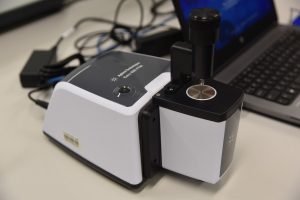 Agilent CARY 630 FTIR spectrometer
Agilent CARY 630 FTIR has been installed with the following operational modules:
- Transmission module – the classic infrared sample interface, which allows for the measurement of liquids or films
- Diamond ATR module – the most common sample interface used in infrared spectroscopy, because it is easy to use and provides high-quality spectra with no sample preparation
- Germanium ATR module – the shallower penetration depth achieved with a Ge crystal results in a shorter path length, allowing simpler characterisation of samples with a high amount of carbon
- Tumbl-IR module – Agilent’s unique liquid transmission sample interface is ideal for rapid analysis of both highly viscous and volatile liquid samples
Purpose:
Used for testing, analysis and characterisation of the vibronic and spectral properties of organics and polymers for biomedical analysis; characterisation of thin polymer resists on silicon wafers; or measurement of the build-up of water at the polymer–substrate boundary that will eventually lead to the failure of the polymer coating.
Material systems: Organic, inorganic, liquid, powder and polymers.
Scale/volume: Individual samples/system analysis.
Specifications/resolution: Fourier Transform Infrared spectrometer with an attenuated total reflectance accessory; collects IR spectra of materials (400 – 4,000 cm-1).
Model: Agilent CARY 630 FTIR spectrometer
Site: The University of Queensland
Location: PC2 Lab, Level 2E, AIBN (Bldg #75), St Lucia
Instrument contact: anff@uq.edu.au


